In procurement meetings for hockey clubs, municipal rinks, school districts, and elite training academies, the conversation has moved far beyond “Is the goal size correct?” or “What’s the unit price?” Decision-makers now evaluate outdoor hockey nets as long-life engineered systems—assets expected to withstand thousands of high-velocity shots, year-round weather exposure, and continuous repositioning without structural fatigue or performance degradation.
When buyers search for an Outdoor hockey net manufacturer China or compare the Best hockey net manufacturer China, they are effectively asking a deeper question: Which supplier can consistently deliver structural integrity, material durability, and lifecycle cost efficiency under real-world conditions?
This article breaks down how a professional Chinese manufacturer translates materials science, welding engineering, and structural design into measurable durability—and how those technical decisions directly reduce maintenance frequency, replacement cycles, and total cost of ownership.
1. Why Outdoor Hockey Nets Fail: A Technical Diagnosis
Before evaluating manufacturing solutions, it is critical to understand failure modes in outdoor hockey nets. These are not theoretical—they are repeatedly observed in training facilities and public rinks.
1.1 Mesh Deformation and Tension Loss
Low-grade nets often use inferior polymer fibers or inconsistent weaving patterns. Under UV exposure and repeated puck impact:
Fibers embrittle and lose elasticity
Knot slippage (in knotted nets) causes uneven load distribution
Net sag increases rebound inconsistency
1.2 Frame Fatigue and Weld Failure
Standard steel frames without proper stress distribution:
Develop microfractures at weld joints
Experience torsional deformation after repeated high-speed shots
Lose geometric alignment, affecting net positioning
1.3 Corrosion and Environmental Degradation
Outdoor installations face:
UV radiation (polymer degradation)
Moisture ingress (internal rusting)
Freeze-thaw cycles (material expansion stress)
1.4 Batch Inconsistency in Large Procurement
For large buyers, inconsistency is a hidden cost driver:
Dimensional deviations affect installation compatibility
Uneven mesh tension impacts training quality
Structural variance complicates maintenance and spare parts planning
2. Material Engineering: The Foundation of Impact Resistance
A high-performance outdoor hockey net begins with material selection aligned to stress profiles.
2.1 Polyester Knotless Mesh: Controlled Elastic Response
Professional-grade outdoor nets increasingly use knotless polyester mesh, not by trend, but due to measurable performance advantages.
Key parameters (example specification):
Engineering advantages:
Eliminates stress concentration points found in knotted designs
Provides consistent energy absorption across the net surface
Maintains tension stability under repeated puck impact
In high-frequency training environments, this translates to:
Reduced deformation zones
More predictable rebound behavior
Longer service life before re-tensioning is required
2.2 Steel Frame with Anti-Deformation Design
The frame must resist both impact force and cumulative fatigue.
Material strategy:
Painted or coated iron pipe (high-strength steel base)
Anti-bending structural geometry
Anti-twisting reinforcement
Critical design considerations:
Pipe diameter vs. impact load threshold
Wall thickness vs. weight optimization
Joint geometry vs. stress dispersion
A properly engineered frame does not simply “hold shape”—it actively distributes impact energy to prevent localized failure.
2.3 Fiberglass Support Rods: Flexible Reinforcement
Replacing rigid secondary supports with fiberglass rods introduces controlled flexibility into the system.
Benefits:
High tensile strength with low weight
Absorbs dynamic loads instead of transferring stress to joints
Reduces risk of permanent deformation
This hybrid structure (steel + fiberglass) is particularly effective in:
3. Welding and Manufacturing Process: Where Durability Is Won or Lost
Material quality alone is insufficient. Manufacturing precision determines whether theoretical strength becomes real-world durability.
3.1 Automated Welding for Structural Consistency
Manual welding introduces variability. Industrial-grade manufacturers implement:
Result:
Uniform joint strength across production batches
Reduced internal stress concentrations
Lower risk of weld cracking under cyclic loading
3.2 Surface Treatment and Anti-Corrosion Strategy
Outdoor durability depends heavily on surface protection systems.
Effective approaches include:
Multi-stage surface cleaning (removal of oil and oxidation)
Anti-rust coating or baking finish
Even coating thickness for full coverage
This prevents:
Internal corrosion propagation
Surface flaking under UV exposure
Structural weakening over time
3.3 Full-Chain Manufacturing Control
One of the defining characteristics of a Best hockey net manufacturer China is vertical integration.
A complete supply chain—from wire production to pipe fabrication—enables:
4. Case Integration: Manufacturing Capability in Practice
A representative example of this integrated approach can be seen in manufacturers such as Riches Net, a company with over two decades of specialization in sports net systems.
Founded in 2000, Huizhou Riches Net Science & Technology Co., Ltd. has developed:
A fully integrated production chain covering rope, mesh, and metal frame components
Automated processes including pipe cutting, punching, bending, welding, and coating
A quality management system ensuring dimensional accuracy, tight mesh structure, and long service life
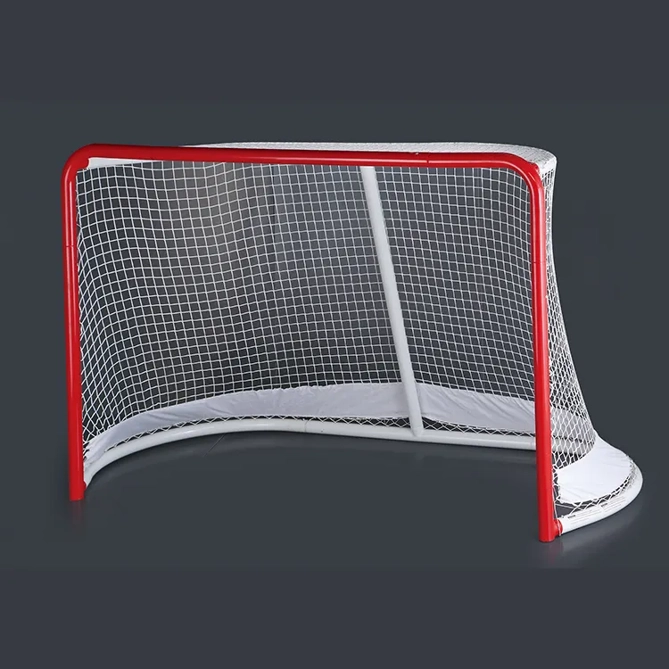
Their outdoor hockey net configuration reflects this engineering philosophy:
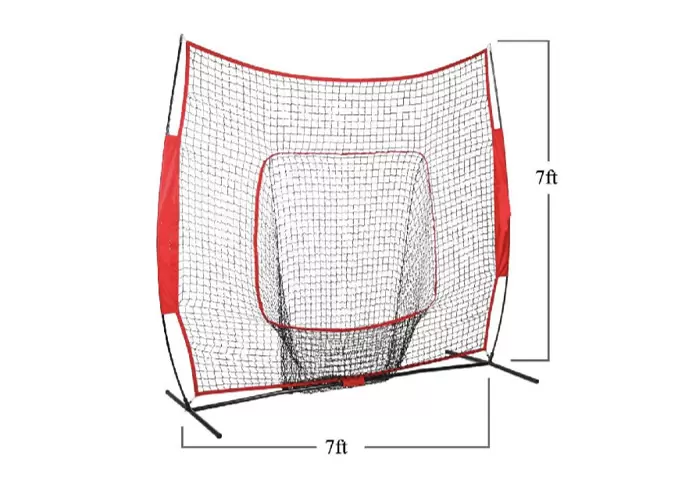
Size: 6 × 6 × 6 ft (standard training format)
Mesh: Polyester knotless, 5 strands × 1.5”, impact-resistant
Frame: Painted steel pipe, anti-bending and anti-twisting
Support: Fiberglass rods for flexibility and strength
Portability: Oxford cloth carrying bag
More importantly, the system is fully customizable:
Mesh density and rope thickness
Frame dimensions and coating options
Modular or portable configurations
This level of customization is not a marketing feature—it is a direct response to varied operational environments.
5. Structural Design and Impact Distribution
5.1 Load Path Optimization
In a well-engineered hockey net:
This requires:
5.2 Anti-Torsion Frame Geometry
Repeated off-center shots create torsional stress.
Design solutions include:
5.3 Modular and Portable Design Without Compromising Strength
For schools and training institutions:
However, portability must not reduce durability.
Engineering solutions:
Detachable yet reinforced joints
Lightweight materials (fiberglass) without structural compromise
Carrying systems that protect components during transport
6. Performance in Real-World Scenarios
6.1 High-Frequency Training Environments
In professional training:
High-quality nets maintain:
Consistent rebound behavior
Structural integrity over extended cycles
Minimal maintenance intervention
6.2 Outdoor Public Facilities
For municipal installations:
Exposure to sun, rain, and temperature fluctuations
Limited maintenance budgets
Durable nets reduce:
Replacement frequency
Repair labor costs
Operational downtime
6.3 School and Institutional Use
For schools:
Well-designed systems provide:
7. Total Cost of Ownership: The Real Procurement Metric
Initial price is only one component. Professional buyers evaluate:
7.1 Maintenance Frequency
Higher-quality materials and construction reduce:
7.2 Lifecycle Duration
Durable systems extend:
7.3 Operational Efficiency
Consistent performance leads to:
8. Batch Consistency and Quality Control in Large Orders
For bulk procurement, consistency is critical.
Key control measures include:
Standardized production parameters
Automated manufacturing processes
Quality inspection at multiple stages
A reliable manufacturer ensures:
This simplifies:
9. Customization as an Engineering Solution
Customization is not optional—it is essential for diverse applications.
Typical customization areas:
Size variations beyond standard 6×6×6 ft
Mesh density adjustments for different training intensities
Enhanced coatings for extreme climates
Portable vs. fixed installation designs
A capable Outdoor hockey net manufacturer China provides these options without compromising production efficiency.
Conclusion
Selecting the Best hockey net manufacturer China is fundamentally an engineering decision, not a sourcing shortcut. The durability of an outdoor hockey net depends on a tightly integrated system of material selection, structural design, and manufacturing precision.
Manufacturers with full-chain capabilities—such as Riches Net—demonstrate how control over every stage of production translates into:
For procurement managers, engineers, and project planners, the priority is clear: evaluate suppliers not by price alone, but by their ability to deliver consistent, high-performance systems under real-world conditions.
In demanding outdoor environments, durability is not a feature—it is the baseline requirement that defines long-term value.