Introduction: Why Modern Pitchers No Longer Train Without Measurable Feedback
In professional baseball development, improvement is no longer defined by repetition alone. The modern pitcher trains inside a feedback-driven system where every throw contributes measurable information about command, rhythm, and mechanical consistency. Whether working with elite athletes, youth development academies, or individual players performing high-frequency practice sessions, one reality has become increasingly clear: training efficiency depends on immediate and reliable feedback.
Traditional throwing drills often fail not because athletes lack discipline, but because training interruptions break neurological learning cycles. Repeated ball retrieval, unclear target visualization, and inconsistent rebound behavior reduce effective repetitions per session. Over time, this lowers motor learning efficiency and slows command development.
For this reason, advanced training environments increasingly rely on two specialized tools:
These are no longer simple containment nets. When engineered correctly, they function as precision training instruments that accelerate control acquisition, reinforce muscle memory, and enable uninterrupted reaction training.
This article examines how structural engineering, material science, and rebound physics combine to create a pitching system capable of supporting continuous, high-intensity training while delivering accurate performance feedback.
The Real Training Problem: Repetition Without Feedback Is Inefficient
Pitchers improve through neural adaptation. Every throw teaches the brain how much force, angle, and timing are required to place the ball within a defined strike zone. However, effective learning requires three conditions:
Clear visual targeting
Immediate outcome recognition
Consistent repetition tempo
When any of these elements is missing, learning efficiency decreases dramatically.
Common Limitations in Conventional Training Nets
Many standard pitching nets introduce hidden inefficiencies:
| Training Issue | Performance Impact |
|---|
| Undefined target area | Poor pitch location awareness |
| Soft or unstable rebound | No reaction training |
| Frame deformation under load | Inconsistent feedback |
| Ball retrieval interruptions | Reduced repetition density |
For youth coaches and independent players training in limited spaces, these inefficiencies compound quickly. A one-hour session may produce only 120–150 meaningful throws instead of 250–300 effective repetitions.
The objective, therefore, is not merely to stop baseballs — it is to convert every throw into actionable feedback.
Engineering the Strike Zone: Turning Visual Targets into Accuracy Development
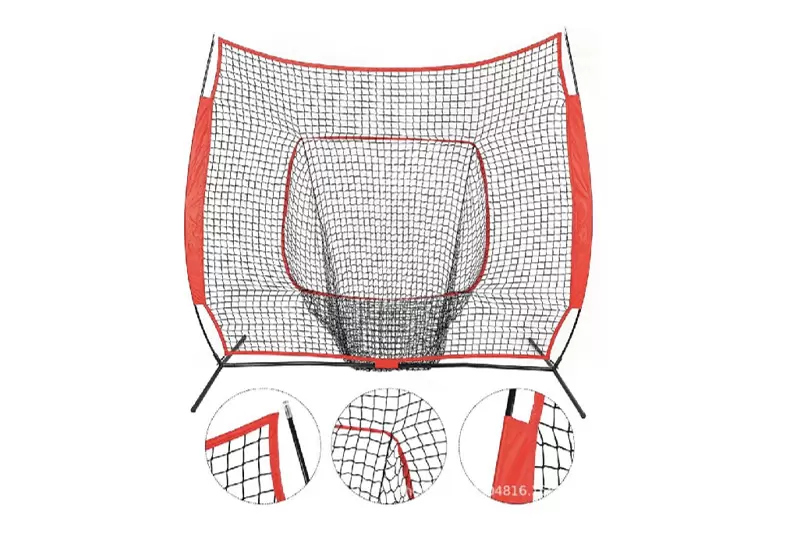
A well-designed Baseball Pitching Net with Strike Zone must replicate how pitchers cognitively process a real batter’s zone. The strike zone is not simply a rectangle; it is a spatial reference that trains depth perception, release timing, and pitch intent.
Precision Zone Design and Cognitive Alignment
The strike zone integrated into the Riches Net system is carefully proportioned relative to the 7×7 FT frame dimension. This size relationship matters because it establishes correct visual scaling at realistic pitching distances.
Key design principles include:
High-contrast zone segmentation for rapid recognition
Stable fabric tension preventing visual distortion
Accurate geometric alignment with pitching trajectory
The use of 420D Oxford fabric ensures that the strike zone maintains shape integrity even after repeated high-velocity impacts. Unlike lighter materials that wrinkle or sag, the reinforced surface preserves consistent visual boundaries, preventing subconscious targeting errors.
For pitchers, this consistency directly improves:
Release point calibration
Vertical command awareness
Edge-of-zone targeting confidence
When visual feedback remains stable, the brain learns faster.
Material Science Behind Durability and Training Consistency
Durability in pitching equipment is not only about longevity; it determines whether feedback remains reliable over thousands of repetitions.
The Riches Net system applies industrial manufacturing logic derived from large-scale sports net production.
Netting Structure: 7-Ply 1.75” Polyester Impact Grid
The net uses 7-ply high-tension polyester netting, engineered to absorb repeated kinetic energy while maintaining structural memory.
Technical advantages:
Multi-filament construction distributes impact force
Reduced localized stress concentration
Controlled deformation and recovery
During pitching impacts, energy transfer follows three stages:
Initial impact absorption
Elastic deformation
Controlled rebound release
Lower-grade nets often overstretch, causing unpredictable rebound angles. The reinforced polyester configuration maintains elasticity within a predictable range, ensuring repeatable feedback.
Frame Engineering: 25×1.0 mm Reinforced Iron Tube System
A pitching net frame functions as the structural backbone of feedback consistency.
Riches Net integrates a 25×1.0 mm iron tube structure, manufactured through automated processes including:
precision cutting
punching
bending
welding
thermal baking finish
This industrial pipeline, developed by Huizhou Riches Net Science & Technology Co., Ltd., allows dimensional accuracy across production batches.
Why this matters for training:
Frame rigidity prevents energy loss
Maintains strike zone alignment
Eliminates vibration-induced rebound variation
When frames flex excessively, rebound angles change subtly with each throw. Over hundreds of repetitions, this inconsistency disrupts motor learning.
A rigid frame stabilizes the training environment — a critical but often overlooked factor.
The Core Innovation: High-Efficiency Bounce-Back System
The defining performance advantage lies in the bounce-back mechanism.
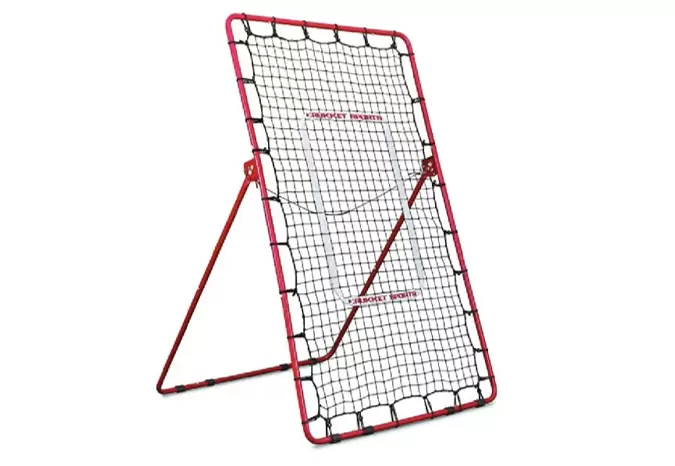
Unlike passive nets that simply absorb energy, a properly engineered Baseball pitching net bounce back system transforms impact energy into controlled return motion.
Predictable Rebound Physics
The Riches Net bounce-back system is tuned to produce:
This predictability enables solo athletes to perform continuous reaction drills without assistance.
Instead of:
Throw → Stop → Retrieve → Reset
Training becomes:
Throw → React → Reset Mechanics → Throw Again
This uninterrupted loop dramatically increases neural engagement.
Why Predictable Rebound Matters for Muscle Memory
Motor learning research shows that timing consistency strengthens neuromuscular pathways. When rebound timing varies, athletes unconsciously adjust posture and rhythm, weakening mechanical stability.
A consistent rebound path allows players to:
maintain throwing cadence
train defensive reactions simultaneously
reinforce rhythm synchronization
The result is dual-skill training:
pitching accuracy
reaction readiness
within a single repetition cycle.
Continuous Training Without Mechanical Fatigue
High-frequency training introduces structural stress not only to equipment but also to learning systems.
The combination of:
ensures the system maintains geometry under repeated impacts.
Because deformation is minimized:
rebound behavior stays constant
visual targeting remains accurate
training outcomes remain measurable
This stability is essential for academies conducting daily multi-athlete sessions.
Training Efficiency: Quantifying the Difference
Let us compare two training environments.
Conventional Setup
150 throws/hour
frequent ball retrieval
inconsistent feedback
Bounce-Back Strike Zone System
Efficiency improvement can exceed 70–100% effective repetitions per session.
For youth development programs, this directly translates into faster skill progression across seasons.
Application Scenarios Across Training Levels
Youth Training Academies
Coaches benefit from visual strike zone feedback allowing athletes to self-correct without constant verbal instruction.
Advantages:
Competitive Pitchers
Advanced players use rebound timing to refine rhythm between pitches, simulating game pacing without needing a catcher.
Individual High-Frequency Practice
Solo athletes gain access to reaction-based drills previously requiring partners or staff support.
Manufacturing Expertise Supporting Performance Reliability
Founded in 2000, Huizhou Riches Net Science & Technology Co., Ltd. brings more than 23 years of specialized manufacturing experience in sports net systems.
The company operates a fully integrated supply chain covering:
wire production
rope processing
net weaving
metal pipe manufacturing
Automation across iron pipe fabrication ensures dimensional consistency and structural reliability — key factors for equipment intended for repetitive kinetic impact.
This vertically integrated production model allows precise control over:
knot tightness
net accuracy
color durability
long service life
Rather than assembling outsourced components, Riches Net manufactures core materials internally, ensuring predictable performance across production runs.
Customization as a Performance Variable, Not a Cosmetic Option
Customization options include:
size adjustment
material variation
color configuration
packaging solutions
From an engineering perspective, customization allows buyers to match training intensity and user groups rather than simply branding products differently.
Training environments vary widely, and equipment must align with usage frequency and athlete level.
Why Strike Zone + Bounce Back Works as a Unified System
The true advantage emerges when both systems operate together.
| Feature | Training Result |
|---|
| Strike Zone | Accuracy feedback |
| Bounce Back | Reaction continuity |
| Reinforced Frame | Feedback stability |
| High-tension Net | Predictable physics |
Together they create a closed-loop training ecosystem:
Visual Aim → Impact Feedback → Immediate Reaction → Mechanical Adjustment.
This loop accelerates learning more effectively than isolated drills.
Decision Factors for Buyers and Project Managers
When evaluating pitching nets for institutional or commercial use, decision-makers should prioritize:
Feedback consistency
Structural durability
Rebound predictability
Manufacturing reliability
The 7×7 FT system size balances realistic target representation with manageable spatial requirements, supporting structured pitching development without sacrificing training realism.
Conclusion: From Equipment to Performance Infrastructure
A modern Baseball Pitching Net with Strike Zone combined with a precision Baseball pitching net bounce back system represents more than a training accessory. It functions as a performance infrastructure enabling measurable improvement.
By integrating engineered rebound behavior, accurate visual targeting, and industrial-grade structural stability, the system transforms individual throws into continuous learning cycles.
Pitchers develop command faster. Coaches manage training more efficiently. Solo athletes achieve reaction-based practice previously unavailable without partners.
Through material engineering, manufacturing precision, and training-focused design, Riches Net delivers a solution aligned with how pitching development actually occurs — through consistent feedback, uninterrupted repetition, and predictable performance environments.