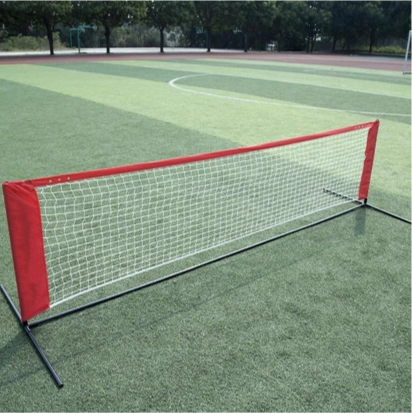
In modern sports equipment engineering, a badminton net system is no longer defined simply by mesh separation between two sides of a court. It is a tension-controlled structural system where mesh elasticity, frame rigidity, anchoring stability, and environmental load resistance must operate in a coordinated mechanical balance.
For procurement engineers, school sports administrators, and facility planners evaluating Portable Badminton Net, the critical performance factor is not only dimensional compliance, but whether the system can maintain consistent net height, uniform tension distribution, and structural alignment under repeated installation cycles and variable outdoor conditions.
At the same time, selecting the Best badminton net requires understanding how material fatigue, lateral wind loading, and frame connection tolerances influence long-term deformation behavior and tension decay characteristics.
Why Portable Badminton Net Systems Are Tension-Controlled Structural Systems
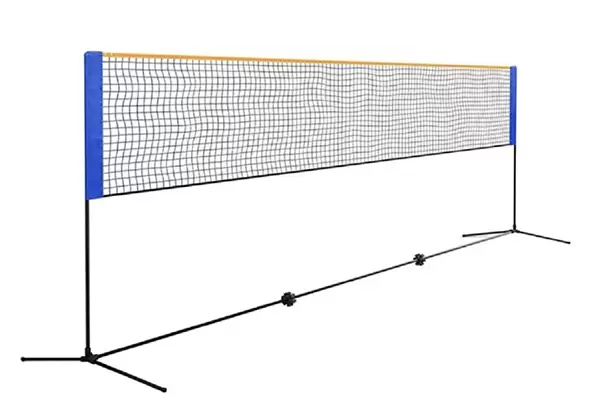
A portable badminton net is fundamentally a pre-tensioned elastic structure system, where performance depends on how effectively mechanical tension is distributed across the net-body and transferred into the support frame.
Unlike fixed court installations, portable systems must repeatedly transition between:
High-tension deployment state during gameplay
Zero-tension folded state during transport
Re-tension recovery state during reinstallation
Each cycle introduces mechanical stress variations that directly affect:
Fiber elongation stability
Frame joint fatigue accumulation
Anchor point micro-displacement
Net height consistency under load
If engineering control is insufficient, long-term degradation typically appears as:
Progressive net sagging at center span due to uneven tension distribution
Frame lateral wobble caused by joint clearance expansion
Height deviation from regulation standards under repeated assembly cycles
Elastic memory loss in net fibers after extended outdoor exposure
Net Material Engineering: Polyester Fiber Structural Behavior
The Best badminton net systems rely on high-strength polyester netting with controlled fiber elasticity characteristics.
In high-performance configurations, such as those produced by Riches Net, established in 2000 with over 23 years of sports net manufacturing experience, the net structure is engineered using:
High-tensile polyester mesh with controlled elongation limits to ensure that vertical deformation remains within regulatory tolerance even under repeated ball impact cycles
Knot-optimized weaving architecture that reduces stress concentration points compared to traditional knotted structures, allowing impact forces to be distributed across multiple fiber intersections rather than localized nodes
UV-stabilized fiber treatment that slows photodegradation under prolonged outdoor exposure, maintaining tensile consistency across seasonal temperature and humidity variations
The result is a net system that maintains stable mechanical behavior even after repeated deformation cycles in training and recreational environments.
Frame Structure Engineering: Steel vs Aluminum Load Behavior
The structural frame determines whether the net system maintains geometric stability under lateral and vertical load conditions.
Steel Frame Systems
Steel-based structures provide:
High rigidity under lateral wind load conditions, reducing frame oscillation during outdoor training sessions
Greater resistance to long-term deformation at joint connection points under repeated assembly cycles
Improved stability under uneven tension distribution across the net span
However, steel systems require careful corrosion resistance treatment to maintain long-term outdoor reliability.
Aluminum Alloy Frame Systems
Aluminum systems provide:
Lower structural mass with reduced inertial response during repositioning
Faster elastic recovery under temporary load displacement
More consistent performance under humid or variable temperature environments
However, they require precise joint tolerance engineering to prevent micro-movement at connection points that could affect net tension alignment.
High Tension Balance Distribution System
One of the most critical engineering innovations in modern portable badminton nets is the tension equilibrium distribution system.
This system ensures that:
Horizontal tension is evenly distributed across the entire net span rather than concentrated at central anchor points
Vertical tension remains stable under repeated ball impact cycles, preventing localized sag formation
Frame-to-net force transfer remains symmetrical even when external load conditions are uneven
Without this system, portable nets tend to experience progressive deformation at mid-span regions due to uneven force accumulation.
Anti-Side Load Structural Design for Outdoor Stability
Outdoor use introduces lateral wind forces that significantly affect net stability.
To counteract this, high-performance systems integrate:
Reinforced lateral support geometry that resists sideward displacement under wind load conditions
Multi-point ground contact structures that distribute lateral force across a wider base area rather than a single anchoring point
Elastic load compensation behavior that allows controlled micro-movement instead of rigid structural failure under sudden wind gusts
This ensures that net height remains within acceptable deviation ranges even under unstable outdoor environmental conditions.
Riches Net Manufacturing Engineering Capability
Riches Net, with over two decades of experience in sports net and structural metal product manufacturing, integrates a fully controlled production system including:
Automated pipe cutting, punching, bending, welding, and coating processes that ensure consistent frame geometry across production batches
Rope-to-net integrated supply chain management that maintains uniform fiber quality from raw material processing to final mesh assembly
Scientific quality control systems that verify dimensional accuracy, knot density consistency, and structural load tolerance before shipment
This vertically integrated manufacturing structure ensures that both net and frame components behave as a unified mechanical system rather than independent parts.
Application Scenarios of Portable Badminton Net Systems
School Sports Programs
Require stable net height retention under frequent setup and teardown cycles, with minimal deviation from official court standards during repeated student usage.
Community Sports Facilities
Require systems capable of maintaining consistent tension under multi-user, high-frequency installation environments where structural alignment must recover quickly after repeated adjustments.
Training Centers
Require high tension stability to support repetitive drill-based play where consistent shuttle trajectory behavior depends on uniform net height and minimal deformation response.
Outdoor Recreational Events
Require resistance to environmental variability including wind, humidity, and uneven ground conditions that can affect frame stability and net tension consistency.
Key Engineering Selection Parameters for Portable Badminton Net
When evaluating Portable Badminton Net systems, procurement and engineering teams typically focus on the following technical dimensions:
Net tension retention coefficient, which defines how effectively the net maintains original tension levels after repeated installation cycles and directly influences long-term height stability during gameplay conditions
Frame structural rigidity rating, which determines resistance to lateral deformation under wind load or accidental player contact during match conditions
Mesh elongation control threshold, which defines how much vertical deformation occurs under repeated shuttle impact and directly affects regulation compliance over time
Joint tolerance precision in frame connectors, which determines whether structural wobble develops during repeated assembly and disassembly cycles
Environmental aging resistance, which defines how material properties change under prolonged UV exposure, humidity variation, and temperature cycling in outdoor environments
High-Strength Structural Design Features in Best Badminton Net Systems
The flagship badminton net systems from Riches Net integrate:
High-tension equilibrium distribution architecture that maintains uniform force spread across the net surface, preventing localized sagging under repeated impact cycles
Anti-lateral deformation frame design that stabilizes structural geometry under wind load and uneven ground conditions
Rapid tension recovery system that allows the net to return to standard height configuration after repeated installation and adjustment cycles
Reinforced connection joint design that reduces mechanical clearance accumulation over long-term use
These combined engineering features ensure that the system maintains consistent performance across diverse usage environments.
Environmental Performance Behavior in Real Usage Conditions
Portable badminton net systems must maintain structural integrity under:
High humidity conditions that can affect fiber elasticity and frame joint friction behavior
Temperature variation cycles that influence material expansion and contraction rates
UV exposure during prolonged outdoor deployment, which gradually affects polymer fiber tensile strength
Repeated mechanical loading from both shuttle impact and accidental human contact
Engineering-grade systems manage these factors through material stabilization and structural compensation design rather than relying on static rigidity alone.
Why Riches Net Systems Maintain Structural Stability
Riches Net’s engineering approach integrates material production, metal fabrication, and structural design under a unified manufacturing system, enabling:
Tight dimensional control across net and frame components
Consistent tensile behavior across production batches
Reduced variability in structural response under field conditions
Long-term durability performance across repeated deployment cycles
This ensures that Portable Badminton Net systems maintain predictable mechanical behavior in real-world sports environments.
Conclusion
A modern Portable Badminton Net system is a tension-controlled structural engineering system where net material behavior, frame rigidity, and load distribution mechanics must operate in coordinated equilibrium.
The true value of the Best badminton net is not defined by basic portability or surface-level usability, but by how consistently it maintains tension stability, structural geometry, and environmental resistance under repeated real-world usage conditions.
For engineers and procurement decision-makers, selection must be based on quantifiable structural performance factors such as tension retention, frame rigidity, and deformation resistance—not superficial product characteristics.
Riches Net delivers badminton net systems engineered for long-term structural stability through integrated material science, frame engineering, and precision manufacturing control.