When coaches, training facility managers, and procurement engineers search for Best baseball net for throwing or evaluate solutions under Baseball Training Net, the underlying technical requirement is rarely about whether the net can simply catch a baseball. The real engineering expectation is far more demanding: whether the system can consistently maintain structural integrity under repeated high-speed throwing cycles, absorb kinetic impact energy efficiently, and control rebound behavior without introducing instability into training performance.
In modern baseball development environments, throwing nets are no longer passive training accessories. They function as impact energy management systems, designed to handle continuous mechanical stress generated by repetitive pitching and throwing drills.
A failure in structural stability does not just reduce equipment lifespan—it directly affects training consistency, athlete performance feedback accuracy, and safety conditions in high-frequency training environments.
This is why industrial-grade design and manufacturing precision are essential in professional baseball training net systems.
Huizhou Riches Net Science & Technology Co., Ltd., established in 2000 with over 23 years of industry expertise, is a specialized manufacturer in sports net systems with a fully integrated production chain covering wire processing, net weaving, and metal structural fabrication. The company operates a complete scientific quality management system that ensures precise specifications, tight knot structure integrity, accurate dimensional control, and long service life performance across all sports net products.
With fully automated iron pipe production systems including cutting, punching, bending, welding, and baking processes, Riches Net delivers engineered sports training systems designed for long-term high-frequency usage with stable structural performance and cost-efficient manufacturing scalability.
The flagship Baseball Training Net is engineered using:
High-density impact-resistant polyester mesh system
Reinforced steel structural support frame
Fiberglass auxiliary support rod architecture
Anti-deformation ground stabilization system
High-tension distributed load net design
Modular quick-assembly structural framework
These engineering components are specifically designed to solve real-world mechanical problems in baseball throwing environments, where repeated high-speed ball impact generates continuous structural fatigue stress.
Understanding What Defines a Baseball Net for Throwing in Engineering Terms
To fully understand Baseball net for throwing systems, it is important to move beyond the basic functional definition and focus on structural engineering requirements.
A baseball throwing net is not simply a catching barrier. In professional training environments, it is a kinetic impact regulation structure that must perform three critical functions simultaneously:
Absorb high-speed ball impact energy
Control rebound trajectory and intensity
Maintain structural geometry under repeated stress cycles
Unlike recreational nets, throwing nets operate under dynamic load conditions where every pitch introduces measurable stress variation across both net fibers and frame structure.
Without proper engineering design, this leads to:
Net fiber fatigue and tearing
Frame bending or structural misalignment
Uncontrolled rebound affecting training accuracy
Rapid degradation under continuous use
Therefore, professional systems must be designed for load distribution stability rather than simple ball containment.
Why Baseball Training Net Selection Is a Structural Engineering Decision
The selection process for a Baseball Training Net is fundamentally a structural engineering evaluation rather than a product purchase decision.
Common failure modes in low-quality systems include:
Polyester fiber elongation under repeated impact cycles
Structural frame deformation due to uneven load distribution
Ground instability during high-frequency training
Loss of net tension leading to reduced energy absorption efficiency
Increased rebound speed over time affecting training control
These issues directly impact:
Pitching accuracy development
Training repetition consistency
Coach reaction timing safety
Long-term operational maintenance cost
Therefore, procurement decisions must focus on long-term structural performance consistency rather than initial appearance or basic functionality claims.
Core Engineering Architecture of Riches Net Baseball Training Net System
The Riches Net Baseball Training Net is built on a three-layer structural engineering system:
High-tension impact absorption net architecture
Reinforced structural frame load-bearing system
Anti-movement stabilized ground support system
Each layer is designed to manage a specific aspect of kinetic energy behavior during throwing training.
1. High-Density Polyester Impact Mesh System
The net system uses industrial-grade high-density polyester mesh material engineered specifically for repeated high-impact baseball throwing conditions.
Multi-Strand Load Distribution Structure
The mesh structure distributes impact force across multiple fiber strands instead of concentrating energy at a single point.
This results in:
Reduced localized fiber stress
Lower probability of mesh rupture
Improved long-term structural durability
Controlled Elastic Energy Absorption
Instead of rigid impact rebound, the polyester structure absorbs kinetic energy and gradually disperses it across the mesh surface.
This improves:
High Tension Stability Retention
The net maintains consistent tension behavior under repeated impact cycles, preventing sagging or deformation over time.
2. Reinforced Steel Frame Structural System
The structural frame is a critical load-bearing component responsible for maintaining system geometry under repeated high-impact stress.
Thickened Steel Pipe Construction
The frame uses Φ25×1.0mm iron pipe bottom structure, engineered for:
Structural Load Distribution Design
Frame geometry is engineered to distribute impact force evenly across multiple structural points, preventing localized stress accumulation.
Long-Term Fatigue Resistance
The steel structure is designed to resist deformation caused by repetitive mechanical loading cycles.
3. Fiberglass Support Frame Stability System
The support structure uses Φ12.7mm fiberglass rods, providing a balance between flexibility and structural strength.
Lightweight Structural Reinforcement
Fiberglass material reduces overall system weight while maintaining sufficient structural rigidity.
Elastic Load Recovery Behavior
Fiberglass rods absorb minor structural vibration and return to original shape after stress release.
4. Ground Stabilization System for High-Frequency Training
A critical factor in throwing net performance is ground stability during repeated use.
Anti-Displacement Base Design
The system includes reinforced ground contact points to prevent movement during high-impact training.
Multi-Surface Adaptability
The structure maintains stability across:
Indoor training floors
Outdoor grass fields
Artificial turf surfaces
High-Frequency Impact Resistance
Designed to maintain position stability during continuous throwing sessions without structural drift.
High Tension Distributed Energy Absorption Technology
One of the most critical engineering innovations in the Riches Net system is the high-tension distributed energy absorption structural design.
This system is engineered to manage varying throwing speeds and impact intensities.
Multi-Zone Energy Dispersion Mechanism
Instead of absorbing impact at a single point, the net distributes kinetic energy across multiple structural zones.
This results in:
Reduced peak stress concentration
Controlled ball deceleration behavior
Improved structural load balancing
Fastball and High-Speed Throw Adaptation
The system dynamically adjusts energy absorption behavior based on impact intensity, allowing stable performance across different throwing speeds.
Reduced Rebound Intensity Control
Energy absorption structure reduces ball rebound speed, improving training control accuracy.
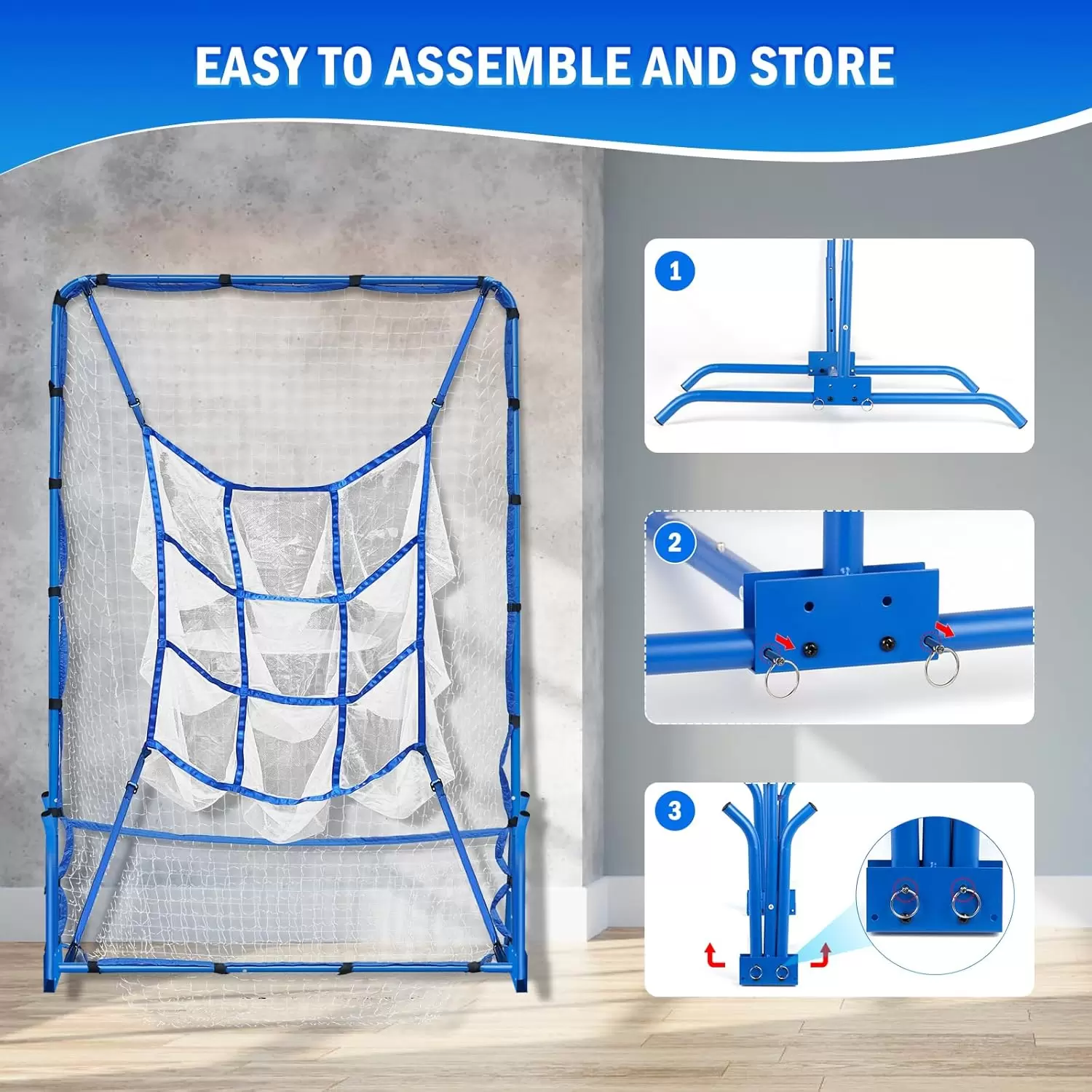
Modular Quick-Assembly Frame System
Operational efficiency is critical in training environments where setup time directly affects usage efficiency.
The modular design enables:
Fast assembly and disassembly
Stable locking between structural components
Easy transition between indoor and outdoor environments
Reduced downtime between training sessions
This is particularly valuable for:
Real-World Training Environment Performance
1. High-Intensity Throwing Drills
Maintains structural integrity under repeated pitching cycles.
2. Accuracy Training Sessions
Ensures stable rebound behavior for consistent throw feedback.
3. Solo High-Frequency Training
Supports continuous throwing without structural fatigue failure.
4. Multi-Athlete Training Environments
Handles simultaneous or sequential training loads without deformation.
Product Engineering Specification Overview
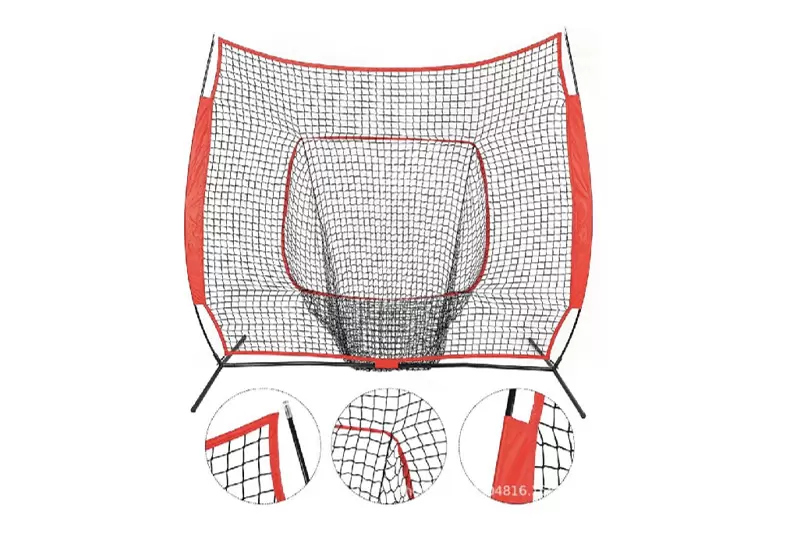
The Baseball Training Net system includes:
Size: 7×7 ft
Net: Polyester mesh material, 7 strands × 1.75” impact resistant
Bottom bracket: Φ25×1.0mm painted iron pipe (anti-bending, anti-twisting, anti-rust)
Support frame: Φ12.7mm fiberglass rod (lightweight + high strength)
Carrying bag: 600D Oxford cloth, high capacity transport design
Customization: color, size, mesh density, rope thickness available
Manufacturing Capability and Industrial Supply Chain Strength
Huizhou Riches Net integrates a fully industrialized production system including:
Wire production and raw material processing
Fully automated pipe cutting and forming systems
Precision punching, bending, welding, and baking processes
Sports net weaving and assembly integration
With over 23 years of manufacturing experience, the company ensures:
High dimensional precision consistency
Tight knot structural stability
Long service life across production batches
Scalable production capacity for global distribution
Key Evaluation Criteria for Buyers
When evaluating Best baseball net for throwing systems, decision-makers should focus on:
Impact Absorption Stability
Ability to consistently handle repeated high-speed throws.
Structural Frame Rigidity
Resistance to bending or deformation under load cycles.
Net Tension Retention
Long-term stability of mesh structure under continuous use.
Ground Stability Performance
Resistance to movement during high-frequency training.
Modular Efficiency
Ease of assembly, disassembly, and replacement.
Conclusion
When evaluating Baseball Training Net systems or identifying the Best baseball net for throwing, the critical engineering factor is not basic ball containment—it is structural performance stability under repeated high-speed impact, long-term fatigue resistance, and controlled energy absorption behavior.
The Riches Net Baseball Training Net is engineered as a high-performance throwing system built on high-density polyester mesh impact absorption, reinforced steel frame architecture, fiberglass structural support, and high-tension distributed energy buffering technology.
By focusing on structural integrity, energy dispersion efficiency, and long-term durability under high-frequency training conditions, Riches Net delivers a professional-grade baseball training system designed for sustained performance in demanding training environments.