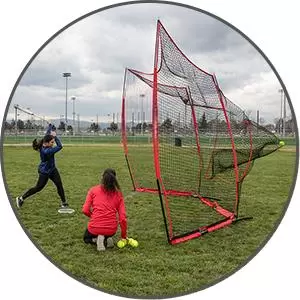
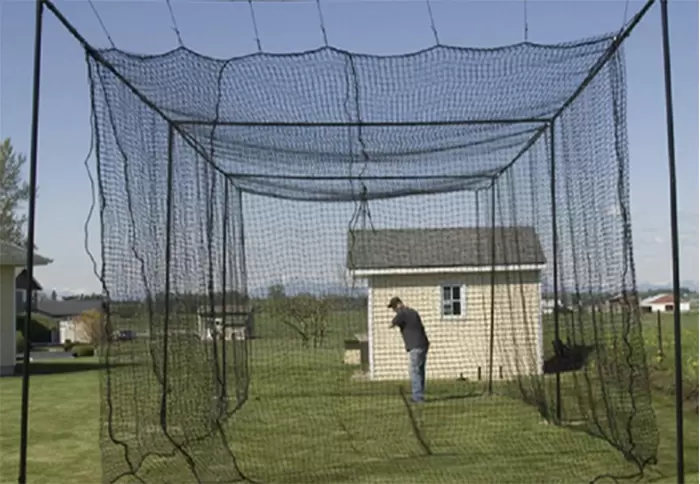
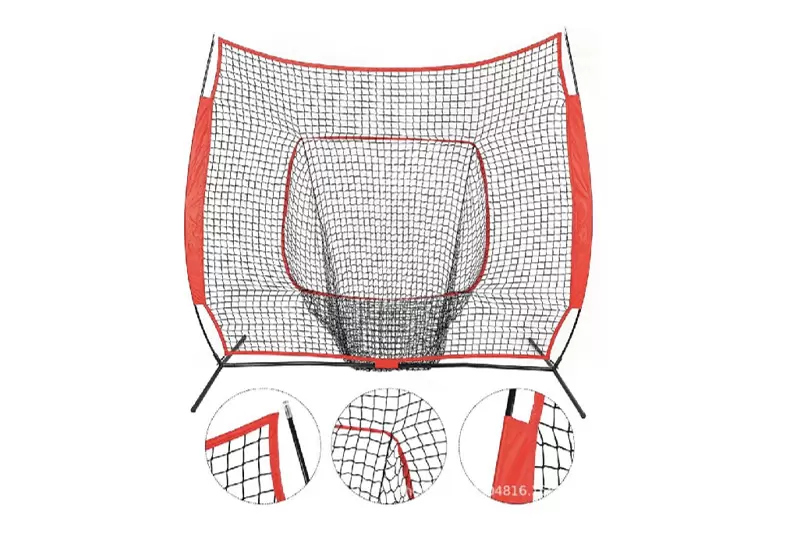
In modern baseball training environments—whether in academies, school programs, private coaching facilities, or high-frequency individual practice setups—the performance of a net system is no longer evaluated by basic usability. For coaches and athletes performing repetitive hitting and receiving drills, the real engineering question behind any Baseball Batting Cage Net or Baseball catcher net replacement is simple:
Does the system maintain consistent training feedback under continuous high-impact load?
Once training intensity increases, especially in batting cage environments where repeated ball velocities are high and impact cycles are continuous, the structural behavior of the net becomes the limiting factor of training quality. A system that stretches unevenly, loses tension, or softens over time does not merely degrade equipment performance—it directly distorts motor learning, timing adaptation, and swing consistency.
This is why professional buyers no longer evaluate catcher nets or batting cage systems as passive accessories. They are treated as dynamic impact absorption systems with defined mechanical response behavior.
From a manufacturing perspective, Huizhou Riches Net Science & Technology Co., Ltd. (Riches Net), established in 2000 with over 23 years of engineering experience in sports net systems, designs baseball training nets not as static mesh products, but as integrated structural systems combining:
Impact-resistant net architecture
Controlled tension distribution design
Reinforced structural framing systems
Long-cycle durability engineering
This article analyzes how Baseball catcher net replacement systems restore training performance and how Baseball Batting Cage Net structures maintain consistency in high-frequency hitting environments.
Why Training Consistency Depends on Net System Engineering, Not Just Durability
In batting and receiving training, consistency is more valuable than raw strength.
A net system may survive impact without breaking, but still fail as a training tool if it:
Changes rebound or deflection behavior over time
Produces inconsistent ball return angles
Develops localized slack zones
Gradually absorbs energy instead of reflecting it predictably
These issues do not cause immediate failure—but they degrade training quality gradually.
In structured hitting environments, athletes rely on predictable feedback loops:
Swing → contact → ball exit response
Catch → return → repetition cycle
Pitch simulation → reaction → correction
When the net’s mechanical response becomes inconsistent, the athlete is no longer training against stable conditions. Instead, they are adapting to equipment variability.
This is especially critical in:
High-repetition batting drills
Soft toss and rapid-fire hitting sequences
Catcher reaction training
Youth development programs focusing on timing consistency
A properly engineered Baseball Batting Cage Net must preserve identical response behavior across thousands of impacts.
Structural Mechanics Behind Baseball Batting Cage Net Performance
A batting cage net system functions as a distributed energy absorption structure.
When a baseball strikes the net:
Kinetic energy is transferred into mesh deformation
Energy is distributed across multiple tension nodes
The net converts impact force into elastic deformation
Controlled recovery returns the system to baseline tension state
The quality of this cycle determines whether the system provides:
Key Engineering Variables
1. Mesh Elastic Response Stability
If the mesh elasticity is too low:
If elasticity is too high:
2. Knot Density and Load Distribution
Knot structure determines whether force is evenly distributed or concentrated.
Poor knot geometry leads to:
3. Tension Retention Over Time
A critical factor in high-frequency training environments.
Without stable tension:
Baseball Catcher Net Replacement as a Performance Restoration System
Unlike initial installations, Baseball catcher net replacement is not simply a maintenance activity—it is a performance restoration process.
Most users begin replacement searches only after experiencing:
However, the key issue is not only physical wear—it is loss of mechanical feedback integrity.
Why Replacement Nets Fail When Poorly Engineered
Low-quality replacement nets often introduce new problems instead of solving existing ones:
1. Frame Incompatibility
Even small dimensional mismatches can cause:
2. Incorrect Elastic Modulus
If the replacement mesh is softer or stiffer than the original:
3. Poor Recovery Rate
After repeated impacts, inferior nets fail to return to baseline tension quickly, causing:
Engineering Requirements for High-Performance Baseball Catcher Net Replacement
A professional-grade replacement system must meet three key performance restoration criteria:
1. Structural Compatibility
Replacement net must match:
Frame geometry
Anchor spacing
Load direction mapping
2. Impact Behavior Matching
The rebound and absorption characteristics must replicate original system behavior to preserve:
3. Long-Term Elastic Stability
The net must maintain:
Tension consistency after repeated cycles
Minimal deformation memory effect
Stable mechanical response curve
Material Engineering: Why Polyester 7-Strand Structure Matters
Riches Net designs its baseball training net systems using 7 strands × 1.75” polyester mesh, specifically engineered for repeated high-impact environments.
This structure provides:
High-Tensile Impact Resistance
Multi-strand polyester distributes impact force across multiple fibers, reducing localized stress failure.
Controlled Elastic Deformation
Ensures the net absorbs energy without excessive rebound distortion.
Long-Term Shape Stability
Reduces progressive stretching under continuous use cycles.
Consistent Training Feedback
Maintains uniform ball response over time.
How Batting Cage Net Systems Maintain High-Frequency Training Stability
In batting cage environments, nets are exposed to:
Continuous high-speed ball impact
Multi-directional force distribution
Repetitive localized stress cycles
A stable Baseball Batting Cage Net must therefore function as a full enclosure system rather than a single mesh panel.
Key Performance Requirements in Batting Cage Applications
1. Anti-Sag Structural Stability
Long-duration training sessions require nets that maintain geometry under cumulative load.
2. Uniform Impact Distribution
The net must prevent localized “dead zones” where rebound behavior differs.
3. Continuous Training Load Resistance
Must support:
4. Safety Containment Integrity
The system must fully contain errant balls without structural deformation.
How Consistency in Net Response Improves Player Development
Training effectiveness depends heavily on repetition quality.
When batting cage nets behave consistently:
Swing timing becomes more repeatable
Pitch recognition improves
Muscle memory stabilizes faster
Reaction timing becomes more precise
When nets degrade:
Players subconsciously adjust to inconsistent feedback
Training results become unreliable
Progress plateaus despite increased effort
Consistency is therefore not a comfort factor—it is a performance multiplier.
The Role of Baseball Catcher Net Replacement in Long-Term Training Systems
Over time, all high-use net systems degrade due to mechanical fatigue.
However, replacing only the net—rather than the full system—offers:
Lower lifecycle cost
Faster equipment recovery
Minimal training interruption
Preservation of structural investment
A properly engineered replacement restores:
This is particularly important for:
Youth academies running daily drills
Coaching centers managing multiple athletes
Individual athletes performing high-repetition training
Riches Net Manufacturing Capability Behind System Reliability
Riches Net provides integrated production capabilities across:
Wire and rope manufacturing
Net weaving and structural assembly
Metal pipe fabrication
Cutting, bending, welding, and baking processes
With over 23 years of industry experience, the company ensures:
Tight knot consistency
Accurate dimensional control
Durable structural output
Stable long-term performance characteristics
The fully automated metal processing system ensures frame components for batting cage structures meet consistent engineering tolerances, improving:
Structural alignment
Load distribution
Long-term durability
Customization for Professional Training Environments
Baseball training environments vary significantly across:
Youth development programs
Indoor training facilities
Outdoor academy fields
Professional coaching setups
Riches Net supports customization for:
This ensures compatibility with different training methodologies and facility layouts.
Conclusion: Why Net System Engineering Defines Training Quality
In high-frequency baseball training environments, the difference between average and elite performance is not determined by how often athletes train, but by how consistently the training system responds.
A properly engineered Baseball Batting Cage Net ensures:
Stable impact absorption
Predictable ball behavior
Long-term structural integrity
Safe high-volume training execution
Meanwhile, a high-quality Baseball catcher net replacement ensures that performance consistency is not lost over time, even after extended use cycles.
Together, they form a complete training system where:
For coaches, athletes, and training facility operators, investing in engineering-grade net systems is not an upgrade—it is a requirement for maintaining reliable skill development pathways.
In professional baseball training, consistency is not a feature of practice—it is a feature of the equipment itself.