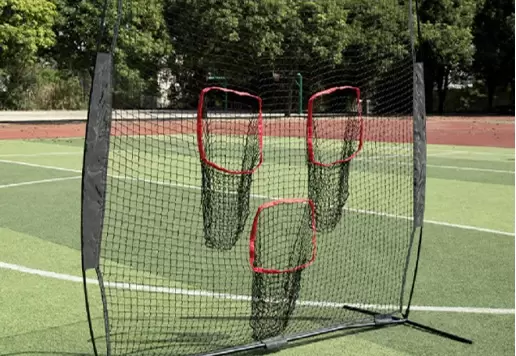
For serious baseball players, coaches, and families investing in repetitive skill development, the best baseball pitchback net is not simply a backyard accessory—it is a mechanical training tool that directly affects reaction speed, throwing accuracy, swing timing, and repetition quality.
Many buyers initially compare baseball rebounders based on visible factors such as size, portability, or price. However, once training intensity increases, those superficial purchase criteria quickly become secondary. What determines whether a rebound trainer actually improves player performance is its ability to deliver repeatable, game-relevant ball return behavior under high-frequency use.
A poorly engineered rebounder may return the ball inconsistently, lose tension after repeated impacts, create erratic rebound angles, or deform structurally during aggressive training sessions. In those situations, the athlete is not practicing efficient mechanics—they are adapting to equipment inconsistency.
Likewise, when the original net wears out, choosing the wrong baseball rebounder net replacement can permanently degrade training quality even if the frame remains intact.
This is why experienced coaches, advanced athletes, and equipment buyers increasingly evaluate pitchback systems from an engineering and performance perspective rather than a consumer-product perspective.
This article explains how the best baseball pitchback net improves solo baseball training through rebound mechanics, frame stability, and material engineering—and why high-quality baseball rebounder net replacement is essential for maintaining real training performance over the equipment’s full lifecycle.
Why Rebound Quality Matters More Than Setup Convenience
A baseball pitchback net exists for one purpose: to return the ball in a controlled, repeatable way that simulates live play conditions.
If rebound behavior changes from throw to throw, the athlete cannot properly train:
Inconsistent rebound trainers create false randomness, not productive variability.
That distinction matters.
Real baseball involves reacting to dynamic but physically logical ball movement. Poor rebounders introduce chaotic returns caused by unstable tension, uneven frame loading, and net deformation—none of which replicate real gameplay.
The best baseball pitchback net must therefore be designed to produce:
Consistent rebound angle
Predictable rebound velocity
Stable directional return across impact zones
Reliable performance under repeated impact loading
Only then can athletes perform high-volume repetitions without compromising training quality.
The Physics Behind Effective Baseball Pitchback Rebound Performance
To understand what separates elite rebounders from entry-level models, it is necessary to understand the mechanics of rebound energy transfer.
When a baseball strikes the net:
The net absorbs kinetic energy
The frame distributes structural load
The net deforms elastically
Stored energy is released back into the ball
The rebound trajectory is determined by tension geometry and impact angle
Any weakness in this system reduces training realism.
Key Variables That Affect Rebound Performance
Net Elasticity Retention
If the net stretches excessively:
Tension Uniformity
If tension varies across the strike zone:
Frame Rigidity
If the frame flexes excessively:
Impact Recovery Speed
If materials recover slowly after impact:
Why Frame Geometry and Angle Adjustment Directly Affect Training Value
Modern athletes use pitchback nets for more than simple throwing drills.
Advanced training requires angle-adjustable rebounders to simulate:
However, angle adjustability only adds value if the frame maintains rigidity at every setting.
Inferior pitchback nets often suffer from:
Angle drift during repeated impact
Uneven support loading
Frame torsion under offset hits
Joint loosening over time
The best baseball pitchback net must preserve rebound consistency regardless of angle setting.
That requires:
Reinforced hinge structures
Positive locking angle mechanisms
Proper weight distribution
Tubular steel thickness sufficient for anti-torsion stability
Without those design elements, angle adjustment becomes a marketing feature rather than a usable training function.
Material Engineering: Why Net Construction Determines Long-Term Performance
The rebound net itself is the most critical wear component in the system.
Low-grade nets often fail in three ways:
Elastic fatigue → rebound becomes dead
Localized tearing → mesh rupture at impact zone
Permanent stretch → rebound inconsistency
To prevent this, premium systems use engineered multi-ply polyester netting.
Why 7-Ply Polyester Netting Matters
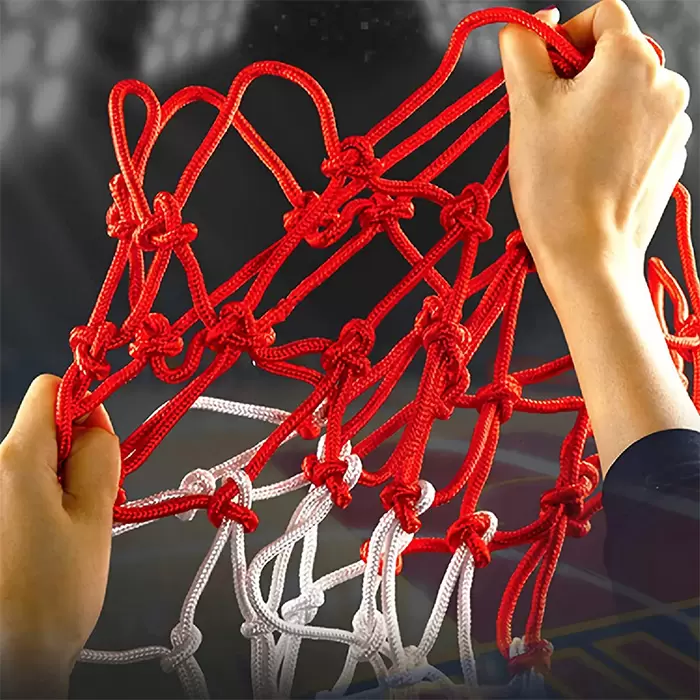
Riches Net manufactures its baseball rebound systems using 7-ply 1.75" black polyester netting, specifically selected for high-frequency baseball impact applications.
This construction provides:
Higher Tensile Strength
Multi-ply braided polyester withstands repeated high-velocity impact far better than thin nylon alternatives.
Better Elastic Memory
Proper rebound depends on net recovery after deformation.
7-ply construction improves shape retention after thousands of impacts.
Improved Knot Stability
Tight, engineered knot structure reduces progressive mesh distortion.
Better UV / Moisture Resistance
Outdoor users require long-term environmental durability.
Why Fabric Reinforcement Around the Strike Zone Matters
Many buyers overlook perimeter reinforcement.
Yet edge abrasion and anchor stress are among the most common failure points in rebound nets.
Riches Net incorporates 420D Oxford fabric reinforcement into high-stress support areas to improve:
Without reinforcement, even strong netting can fail prematurely at mounting interfaces.
Steel Tube Engineering: Why Frame Thickness Impacts Repetition Quality
The frame is not passive—it directly influences rebound energy return.
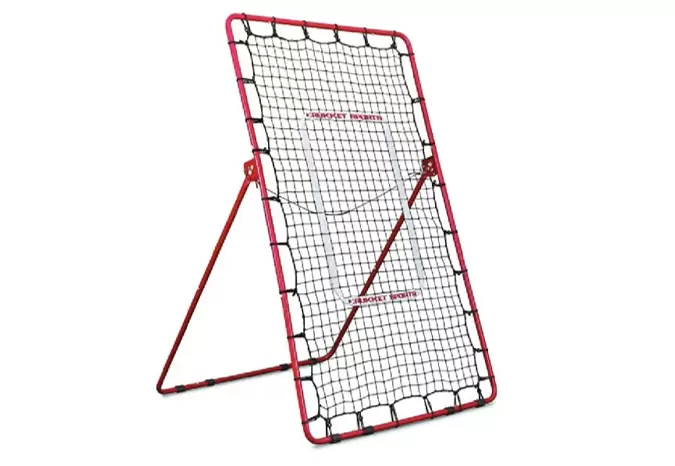
Riches Net uses 22×1.0mm iron tubing for its standard baseball pitchback net frame.
This specification balances:
Structural Rigidity
Enough wall thickness to prevent deformation during repeated impact.
Weight Efficiency
Portable enough for family and solo users.
Controlled Flex Behavior
Allows minimal engineered deflection without unstable wobble.
Weld and Joint Reliability
Compatible with automated welding for consistent structural quality.
Frames that are too thin:
How the Best Baseball Pitchback Net Improves Solo Training Efficiency
One of the greatest values of rebound trainers is enabling high-density solo repetition.
Without a rebound trainer:
Every throw requires retrieval/reset
Rhythm breaks constantly
Mechanical consistency drops
Total reps per session remain low
With a properly engineered rebound net:
Performance Benefits of High-Repetition Solo Training
Faster Reaction Development
Predictable rebound timing allows athletes to train visual recognition and first-step reaction.
Improved Throwing Accuracy
Athletes receive immediate feedback based on rebound direction.
Better Defensive Mechanics
Continuous reps reinforce fielding posture and glove positioning.
Higher Training Volume
More reps per minute equals faster skill acquisition.
How Pitchback Nets Reduce Arm Fatigue During Throwing Practice
Many players assume rebounders increase workload.
In reality, properly designed rebound systems often reduce unnecessary arm fatigue.
Why?
Because they improve repetition efficiency.
Instead of:
Athletes can maintain:
This reduces:
Non-productive movement fatigue
Mechanical breakdown from awkward resets
Shoulder/elbow stress caused by inconsistent throwing cadence
For pitchers and position players performing high-volume mechanics work, this is highly valuable.
Why Baseball Rebounder Net Replacement Is Critical to Maintaining Training Quality
Many users assume that if the frame remains intact, any replacement net will suffice.
That is incorrect.
A baseball rebounder net replacement is not merely a repair part—it is the core rebound engine of the trainer.
If replacement net quality is poor:
Common Problems with Low-Quality Replacement Nets
Poor Frame Compatibility
Improper sizing causes:
Uneven tension
Sagging corners
Distorted strike zones
Reduced rebound symmetry
Inferior Material Strength
Low-ply netting quickly stretches or tears.
Weak Knot Construction
Knots slip under repeated load.
Poor Elastic Recovery
Net remains deformed after impact.
What a High-Quality Baseball Rebounder Net Replacement Should Deliver
A true performance-grade replacement net must restore the rebounder close to original factory condition.
That means:
Precise Dimensional Compatibility
The replacement net must match:
Frame width
Frame height
Anchor-point spacing
Mounting geometry
Equivalent Material Strength
Replacement material must match or exceed OEM ply rating.
Consistent Mesh Geometry
Uniform knot spacing ensures balanced rebound.
Installation Tension Integrity
Net must tension properly without excessive manual adjustment.
Why High-Quality Replacement Nets Extend Equipment Lifecycle
For schools, academies, coaches, and heavy-use households, replacing the full rebounder every time the net wears out is inefficient.
A premium baseball rebounder net replacement allows buyers to:
Preserve frame investment
Restore original rebound behavior
Lower long-term ownership cost
Maintain uninterrupted training schedules
This is especially important for institutions managing multiple units.
Riches Net: Manufacturing Capability Behind Professional Rebound Performance
When evaluating suppliers for baseball training equipment, manufacturing capability matters as much as product design.
Huizhou Riches Net Science & Technology Co., Ltd., established in 2000, brings more than 23 years of specialized production experience in sports net engineering.
Its manufacturing advantages include:
Vertically Integrated Supply Chain
Riches Net controls production from:
Wire manufacturing
Rope processing
Net fabrication
Metal pipe forming
Welding and bending
Surface finishing
This enables tighter control over:
Material consistency
Dimensional accuracy
Lead times
Cost efficiency
Automated Steel Processing
In-house automated production covers:
Pipe cutting
Punching
Bending
Welding
Baking/finishing
Resulting in:
Scientific Quality Management
Riches Net’s manufacturing systems ensure:
Product Configuration Designed for Serious Training Use
Riches Net’s standard baseball pitchback net platform is engineered for real-world baseball training demands:
Product Specifications
Overall Size: 42 × 49 × 31 inches
Net Material: 7-ply 1.75" black polyester netting
Fabric Reinforcement: 420D Oxford fabric
Frame Material: 22×1.0mm iron tube
Available Customization
Riches Net supports OEM/ODM customization for:
Size adjustments
Net color
Material upgrades
Packaging customization
This makes the platform suitable for:
How Buyers Should Evaluate the Best Baseball Pitchback Net
When sourcing or purchasing, decision-makers should prioritize the following:
1. Rebound Consistency Over Marketing Claims
Ask for:
2. Material Specifications
Require:
Ply count
Net material type
Tube thickness
Fabric denier rating
3. Replacement Net Availability
Ensure long-term supply of compatible baseball rebounder net replacement.
4. Supplier Manufacturing Depth
Favor vertically integrated manufacturers over trading-only suppliers.
Final Thoughts: Why Rebound Engineering Defines Training Results
The best baseball pitchback net is not determined by appearance, portability, or low price.
It is determined by one core factor:
How accurately and consistently it converts baseball impact into repeatable, game-relevant rebound performance over thousands of repetitions.
When properly engineered, a baseball pitchback net becomes one of the most efficient solo training tools available—improving:
Reaction speed
Throwing precision
Defensive mechanics
Hitting recognition
Training volume
Movement efficiency
And when paired with a properly engineered baseball rebounder net replacement, that performance can be maintained for years without replacing the full unit.
For buyers seeking long-term reliability, true rebound consistency, and industrial-grade manufacturing support, sourcing from an experienced producer such as Riches Net offers both product performance and supply-chain confidence.
In baseball training, repetition builds skill—but only when every repetition is built on consistent rebound mechanics.
That is why rebound engineering—not convenience—is what truly defines the best baseball pitchback net.