Introduction: Why Rebound Accuracy Has Become the Core Metric of Modern Tennis Training
In contemporary tennis development environments, consistency is no longer built solely through partner rallies. Players—from competitive juniors to advanced individual athletes—now rely heavily on structured solo training systems to refine timing, control, and reaction mechanics. However, not all rebound training tools produce meaningful improvement. The decisive factor is no longer whether a rebound net returns the ball, but how accurately it reproduces real match feedback.
For buyers evaluating the Best tennis rebound wall net adjustable angle or planning long-term Tennis rebound wall net replacement, three performance criteria consistently dominate purchasing decisions:
Rebound realism — whether ball trajectory mirrors an actual opponent’s return.
Adjustable training geometry — the ability to simulate multiple rally scenarios.
Structural stability under repetitive impact — maintaining identical feedback after thousands of strikes.
Players training alone depend entirely on the predictability of rebound behavior. If rebound angles drift, tension changes, or structural vibration increases, athletes unknowingly adapt to incorrect feedback patterns. Over time, this leads to timing errors, misjudged swing paths, and inefficient footwork development.
This article examines how engineering-driven design—particularly adjustable rebound angles, controlled tension systems, and high-elastic impact materials—transforms rebound nets from simple practice equipment into precision training systems capable of accelerating skill acquisition.
The Physics Behind Realistic Tennis Rebound Training
Why Rebound Consistency Matters More Than Return Speed
When a tennis ball contacts a rebound net, three physical processes occur simultaneously:
Energy absorption by the mesh
Directional redirection through angle geometry
Energy restitution producing the return trajectory
In poorly engineered systems, these processes vary with each hit, producing inconsistent ball paths. Advanced training requires the opposite: predictable energy transfer.
A realistic rebound must replicate:
If rebound timing fluctuates even slightly, players subconsciously alter swing tempo. Over hundreds of repetitions, incorrect rhythm becomes ingrained into muscle memory.
Therefore, rebound accuracy depends primarily on:
Adjustable Angle: The Core Technology Behind Advanced Rebound Systems
Why Fixed-Angle Nets Limit Player Development
Traditional rebound nets operate at a single incline angle. While acceptable for casual practice, fixed geometry prevents simulation of real match variability.
Tennis rallies involve constantly changing ball trajectories:
| Scenario | Required Return Behavior |
|---|
| Baseline rally | Deep looping rebound |
| Fast exchange | Low, quick return |
| Volley training | Short reaction rebound |
| Defensive recovery | Higher arc trajectory |
A fixed-angle system can reproduce only one of these effectively.
Multi-Angle Rebound Engineering
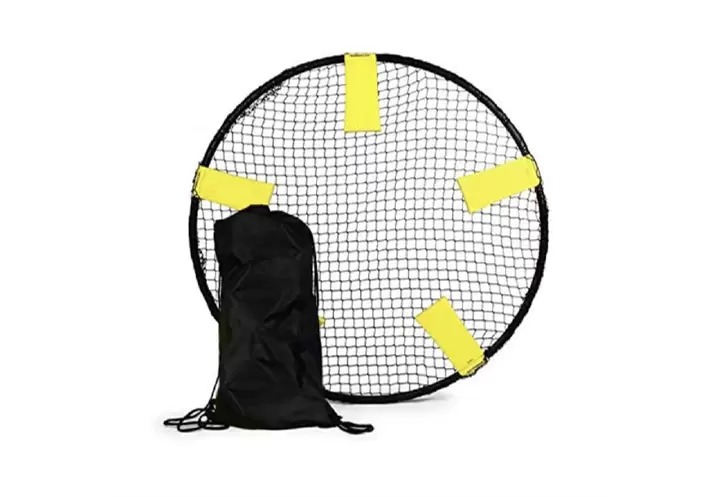
The flagship Tennis Rebound Wall Net (Adjustable Angle) introduces a controlled angular adjustment mechanism that modifies rebound physics directly.
Changing the net inclination alters:
Reflection angle
Return velocity
Ball spin preservation
Reaction time window
Example Effects:
Steeper Angle (Forward Lean)
Neutral Angle
Backward Angle
Higher rebound arc
Topspin simulation
Footwork recovery drills
This transforms one training station into multiple tactical environments.
Controlled Feedback: How Angle Precision Builds Muscle Memory
Muscle memory forms through repetition under consistent feedback conditions. Random variation disrupts learning efficiency.
The adjustable system incorporates precision angle locking, ensuring:
Identical rebound behavior across sessions
No gradual drift during repeated impacts
Repeatable training setups for coaching programs
For academies and professional training environments, this enables standardized drills where players experience identical ball responses daily.
Consistency directly accelerates:
High-Elastic Impact Netting: Engineering the Rebound Surface
Material Selection: PET and PP Performance Advantages
The rebound surface uses engineered combinations of PET and PP materials, chosen specifically for repeated high-energy ball impact environments.
Key performance characteristics:
| Property | Training Impact |
|---|
| Elastic recovery | Stable rebound trajectory |
| Impact resistance | Prevents deformation |
| Low fatigue rate | Maintains tension over time |
| Weather durability | Outdoor reliability |
Unlike softer recreational meshes, engineered twisted-rope construction maintains structural elasticity after extensive usage cycles.
Rope Diameter and Performance Tuning
Available diameters:
2 mm — faster rebound response
4 mm — balanced control and durability
6 mm — maximum structural stability for intensive training
Diameter directly influences energy absorption:
Procurement teams can therefore match specifications to training intensity levels.
Mesh Geometry and Ball Interaction
Mesh sizes include:
Smaller mesh spacing distributes impact forces more evenly, preventing localized deformation and ensuring consistent rebound angles.
Structural Stability Under High-Frequency Training
The Hidden Problem: Progressive Tension Loss
Many rebound nets perform well initially but degrade after repeated impact cycles due to:
When tension changes, rebound trajectories shift subtly—often unnoticed until performance declines.
Engineering Against Deformation
The adjustable rebound system uses:
twisted rope processing for uniform load distribution
reinforced frame geometry
stable anchoring points aligned with impact vectors
This ensures the rebound surface returns to its original position after each strike rather than gradually sagging.
Why Replacement Nets Matter in Professional Training Systems
Understanding Tennis Rebound Wall Net Replacement Cycles
Even high-quality nets eventually experience material fatigue after extensive usage.
Professional buyers increasingly consider Tennis rebound wall net replacement as part of lifecycle planning rather than emergency maintenance.
Replacement-ready systems provide:
Compatibility and Performance Retention
Replacement nets manufactured with identical specifications preserve:
rebound angle characteristics
training timing consistency
athlete adaptation continuity
Switching to non-matching replacement meshes often alters rebound speed and arc, forcing athletes to recalibrate learned timing.
Manufacturing Precision as a Performance Factor
Performance stability begins at manufacturing consistency.
Riches Net, produced by Huizhou Riches Net Science & Technology Co., Ltd., integrates over 23 years of specialized sports net engineering experience into rebound system production.
Rather than outsourcing components, the company maintains a fully integrated supply chain—from wire production to finished net assembly—ensuring dimensional accuracy and repeatable quality.
Key manufacturing advantages include:
scientifically managed quality systems
experienced technical personnel
precise knot and rope processing
accurate mesh dimensions
long service life through controlled material handling
Automated metal pipe production processes—including cutting, punching, bending, welding, and baking—ensure structural frames maintain consistent geometry essential for reliable rebound physics.
This manufacturing consistency directly translates into predictable training outcomes.
Training Scenario Simulation Through Adjustable Angles
Baseline Rally Simulation
Neutral positioning reproduces rally tempo, allowing players to practice:
depth control
topspin consistency
endurance rhythm
Players can maintain continuous rally cadence without partner variability.
Volley and Reaction Training
Forward angle settings shorten rebound distance and increase speed, forcing rapid preparation and compact swings.
Benefits include:
Defensive Recovery Training
Backward angles generate higher arcs, mimicking defensive returns.
Players train:
recovery footwork
high-contact timing
spin adaptation
Predictable Feedback and Cognitive Training
Consistent rebound trajectories help players develop anticipatory skills.
Because rebound timing remains stable:
This transforms mechanical repetition into neurological learning.
Long-Term Structural Reliability in Outdoor Training Environments
Outdoor use introduces variables such as humidity, UV exposure, and temperature changes.
PET/PP materials combined with twisted rope construction resist:
Color options (green and black) maintain visual clarity without affecting structural properties.
Procurement Considerations for Clubs and Training Academies
When selecting a rebound system, decision-makers should evaluate:
Angle adjustment precision
Material fatigue resistance
Replacement compatibility
Mesh geometry consistency
Manufacturing quality control
Focusing solely on price often results in inconsistent training feedback and higher replacement frequency.
Customization as a Performance Strategy
Custom sizing and configuration allow facilities to tailor rebound response to player level.
Available customization options include:
rope thickness
mesh density
net dimensions
color selection
Customization ensures the rebound system aligns with training philosophy rather than forcing athletes to adapt to equipment limitations.
The Role of Controlled Rebound in Skill Acceleration
Training efficiency increases when feedback remains constant.
Adjustable rebound systems allow players to train multiple tactical situations within one structured environment, enabling:
Consistency reduces wasted repetitions caused by unpredictable ball returns.
Conclusion: Engineering Precision Defines the Best Tennis Rebound Wall Net Adjustable Angle
Modern tennis training demands equipment that behaves like a reliable training partner rather than a passive target. The Best tennis rebound wall net adjustable angle achieves this by combining controlled rebound physics, adjustable geometry, and durable material engineering into a unified performance system.
Through high-elastic PET/PP net construction, precision angle locking, and structurally stable design, players can simulate baseline rallies, reaction exchanges, and tactical scenarios while maintaining consistent feedback essential for muscle memory formation.
Equally important, properly engineered Tennis rebound wall net replacement solutions ensure long-term training continuity, preserving learned timing and performance stability.
Supported by the manufacturing expertise and integrated production capabilities of Riches Net, these systems demonstrate how engineering precision—not convenience features—defines true professional training equipment. When rebound behavior becomes predictable, athletes gain the one training advantage that matters most: repeatable improvement built on reliable feedback.